









































You are looking at the documentation of a prior release. To read the documentation of the latest release, please
visit here.
New to KubeDB? Please start here.
Reconfiguring Qdrant
This guide will give an overview on how KubeDB Ops-manager operator reconfigures Qdrant database.
Before You Begin
- You should be familiar with the following
KubeDBconcepts:
How Reconfiguring Qdrant Process Works
The following diagram shows how KubeDB Ops-manager operator reconfigures Qdrant database. Open the image in a new tab to see the enlarged version.
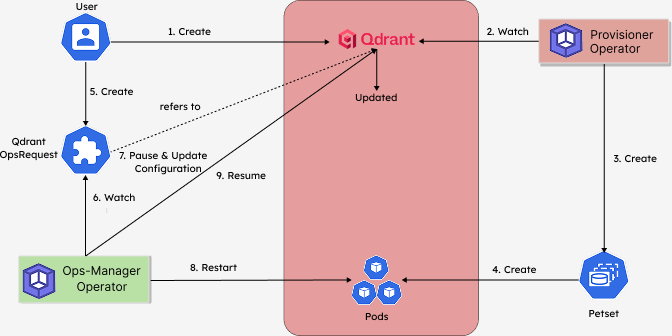
The Reconfiguring Qdrant process consists of the following steps:
At first, a user creates a
QdrantCustom Resource (CR).KubeDBProvisioner operator watches theQdrantCR.When the operator finds a
QdrantCR, it creates required number ofPetSetsand related necessary stuff like secrets, services, etc.Then, in order to reconfigure the
Qdrantdatabase the user creates aQdrantOpsRequestCR with desired information.KubeDBOps-manager operator watches theQdrantOpsRequestCR.When it finds a
QdrantOpsRequestCR, it halts theQdrantobject which is referred from theQdrantOpsRequest. So, theKubeDBProvisioner operator doesn’t perform any operations on theQdrantobject during the reconfiguring process.Then the
KubeDBOps-manager operator will replace the existing configuration with the new configuration provided or merge the new configuration with the existing configuration according to theQdrantOpsRequestCR.Then the
KubeDBOps-manager operator will restart the related PetSet Pods so that they restart with the new configuration defined in theQdrantOpsRequestCR.After the successful reconfiguring of the
Qdrant, theKubeDBOps-manager operator resumes theQdrantobject so that theKubeDBProvisioner operator resumes its usual operations.
In the next docs, we are going to show a step-by-step guide on reconfiguring Qdrant database using QdrantOpsRequest CR.