






































Deploy and manage 25+ Production-grade databases as native Kubernetes resources on Red Hat OpenShift. Run production databases with full automation, governance, and portability across on-prem, cloud, edge, and air-gapped environments. If you're running applications on Red Hat OpenShift, you benefit from enterprise Kubernetes with enhanced security and developer experience. KubeDB extends these benefits to your database layer with native operator patterns. KubeDB enhances OpenShift by making databases first-class citizens in your platform: Launch databases in minutes with OpenShift Operators. Meet regulatory requirements with OpenShift security. Run on-prem, cloud, or edge with consistent workflows. Run databases on OpenShift Virtualization or containers. The KubeDB Operator sits directly on top of your OpenShift platform, leveraging OpenShift's enterprise security, operator framework, and multi-cluster capabilities. 25+ Database engines with HA, scaling, backup, TLS, monitoring, and GitOps support KubeDB integrates deeply with Red Hat OpenShift, supporting OpenShift Data Foundation (ODF), CSI drivers, and both containerized and virtualized workloads. Databases run with full security context constraints and enterprise-grade isolation. Complete data ownership with Red Hat OpenShift's security features including SELinux, seccomp, and Pod Security Admission. Support for air-gapped, FIPS-140-2, and highly regulated environments. Manage 25+ Database engines including PostgreSQL, MySQL, MongoDB, Redis, Elasticsearch, Kafka, and more, all with consistent Kubernetes-native workflows on both containers and VMs. Declarative operators handle provisioning, upgrades, scaling, and repair with zero-downtime where possible. Multi-zone clustering, automated failover, PodDisruptionBudgets, and continuous health checks with Red Hat OpenShift Operator Hub integration. Integrated with KubeStash for policy-driven, incremental, encrypted backups to S3-compatible storage. Support for point-in-time recovery. Native Prometheus + Grafana dashboards. Integrates with Red Hat OpenShift monitoring stack and Red Hat Advanced Cluster Management. Automated TLS, Transparent Data Encryption, RBAC integration with Red Hat OpenShift OAuth, network policies, and Red Hat Compliance Operator support. Run databases on Red Hat OpenShift alongside legacy Virtualized workloads, Windows applications, or Bare Metal deployments. 25+ Database engines managed with Kubernetes-native workflows KubeDB delivers broader support, lower cost, and true Kubernetes-native experience on your existing OpenShift platform.Run Any Database Natively on
Red Hat OpenShift —
Without the CompromiseWhat This Means for Red Hat OpenShift Users
Faster Time-to-Value
Enterprise Compliance
Hybrid Flexibility
VM & Container Support
KubeDB runs natively on Red Hat OpenShift
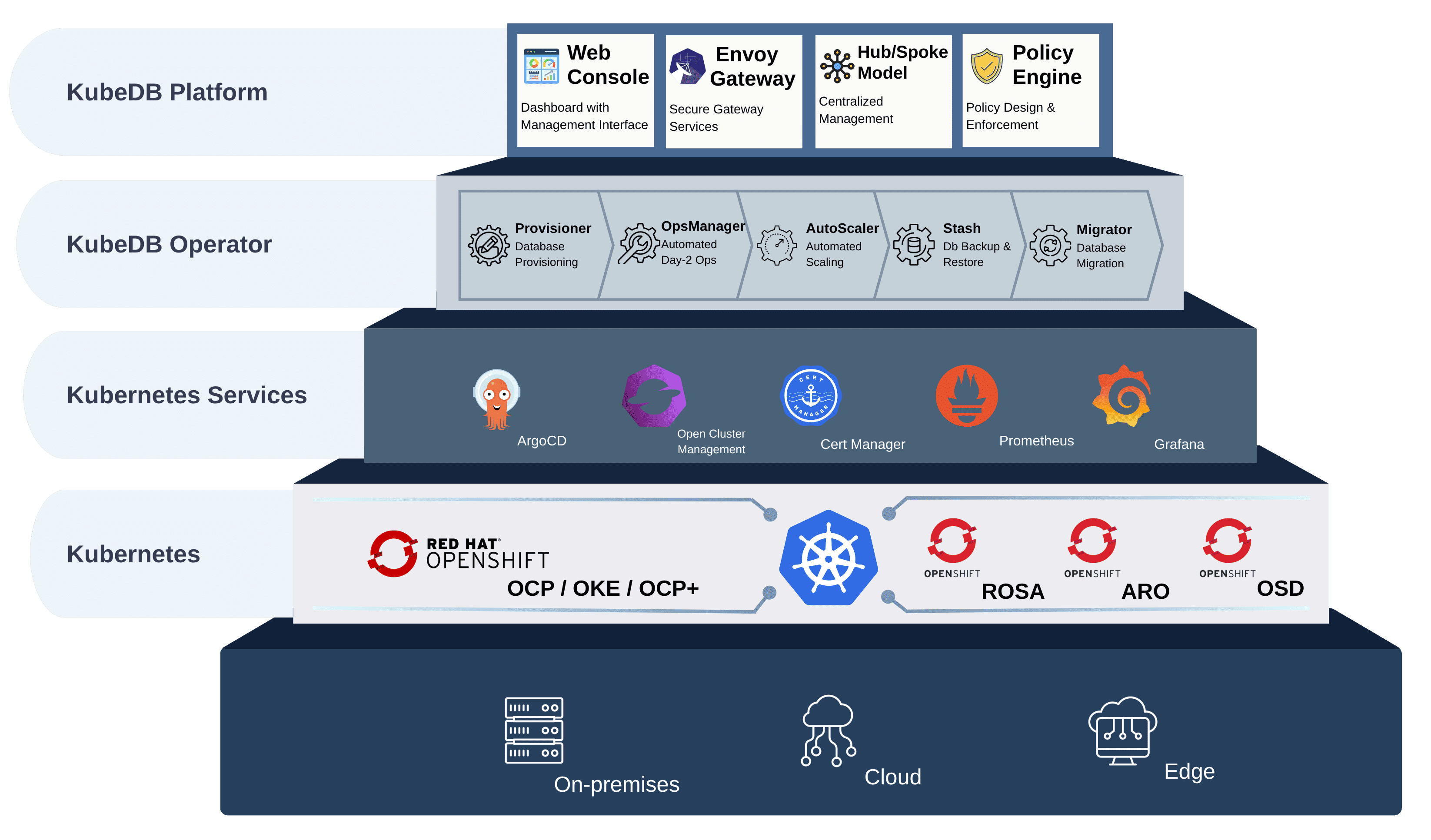
Production databases. Fully automated on Red Hat OpenShift.
Run Databases Natively on Red Hat OpenShift
Enterprise-Grade Security & Compliance
Broad Database Support
Automated Lifecycle Management
High Availability & Resiliency
Backup & Recovery
Monitoring & Observability
Security & Governance
Legacy Workloads
Comprehensive Database Support
KubeDB on MKE delivers what traditional DB management can't
Run Databases Natively
on Red Hat OpenShift
Enterprise security, hybrid cloud freedom, certified operators
Deploy 25+ databases in <60s Full OpenShift RBAC & SCC integration Run anywhere: OCP, ROSA, ARO, OSD, OKE, OCP+