






























KubeDB Operator extends Kubernetes with database-aware automation, Database Engines Production Deployments Time to Deploy Response SLA Perfect for teams who want database automation without platform overhead Deploy and manage databases for your internal teams and applications Customize database configurations to meet your specific requirements Empower your platform team with powerful database automation tools Seamlessly integrate with tools like ArgoCD and GitOps workflows Begin with operator-based automation and scale up as you grow Build custom solutions on top of KubeDB's automation capabilities Bundle KubeDB as part of your application deployment Get powerful automation while maintaining standard Kubernetes workflows Eliminate manual database operations with Kubernetes-native automation Support for PostgreSQL, MySQL, MongoDB, Redis, Elasticsearch, Kafka, and 25+ more databases, all managed through a unified platform. Built-in TLS/SSL encryption, RBAC integration, network policies, and security best practices enforced by default. Automatic failover, replica management, and self-healing capabilities ensure your databases stay online 24/7. Scheduled backups with point-in-time recovery using Stash Enterprise. Restore databases to any point within retention period. Built-in Prometheus metrics, custom dashboards, and alerting to keep your databases performing at peak efficiency. Run on AWS, GCP, Azure, on-premises, or edge locations. One platform works everywhere Kubernetes runs. Full support for isolated, air-gapped environments with private registries and no external dependencies. Scale up resources or add replicas dynamically without downtime. Handle growing workloads effortlessly. Full declarative configuration via YAML manifests. Integrate seamlessly with ArgoCD, Flux, and other GitOps tools. Full lifecycle management for all major databases From startups to enterprises, KubeDB Operator scales with you Spin up dev/test databases instantly without waiting for infrastructure teams Build internal database platforms with self-service capabilities Modernize database infrastructure by migrating to Kubernetes KubeDB Operator provides database automation inside a single kubernetes cluster, while KubeDB Platform extends this into a centralized DBaaS across clusters, teams and environments. Best for teams that want to run and automate databases inside a Kubernetes cluster using declarative APIs. Designed for organizations that need to deliver a standardized, self-service DBaaS across multiple clusters, teams, and environments with centralized control and governance. The Operator is the engine. The Platform is the car. The Platform provides centralized control and governance, orchestrating multiple Operator instances across different clusters and environments. You bring the infrastructure. We bring the software that transforms it Everything you need to know about KubeDB Operator Still have more questions? Join thousands of teams running production databases onRun Production Databases
Natively on Kubernetes
enabling teams to run production databases using declarative APIs.25+
10K+
<1 min
99.9%
When to Use KubeDB Operator
Run databases for internal usage
Full control and customization
Internal platform engineering team
Integrate with existing CI/CD
Starting DBaaS journey on Kubernetes
Use KubeDB as a building block
Package KubeDB with your application
Automation without centralized platform
Why KubeDB Operator?
25+ Database Engines
Production-Grade Security
High Availability
Automated Backup & Recovery
Performance Monitoring
Multi-Cloud & Hybrid
Air-Gapped Deployments
Vertical & Horizontal Scaling
GitOps Ready
25+ Production-Ready
Database OperatorsPerfect For Every Team
Development Teams
Platform Engineering
Cloud-native Transformation
Operator vs Platform: What's the Difference?
KubeDB Operator
KubeDB Platform
Think of it this way:
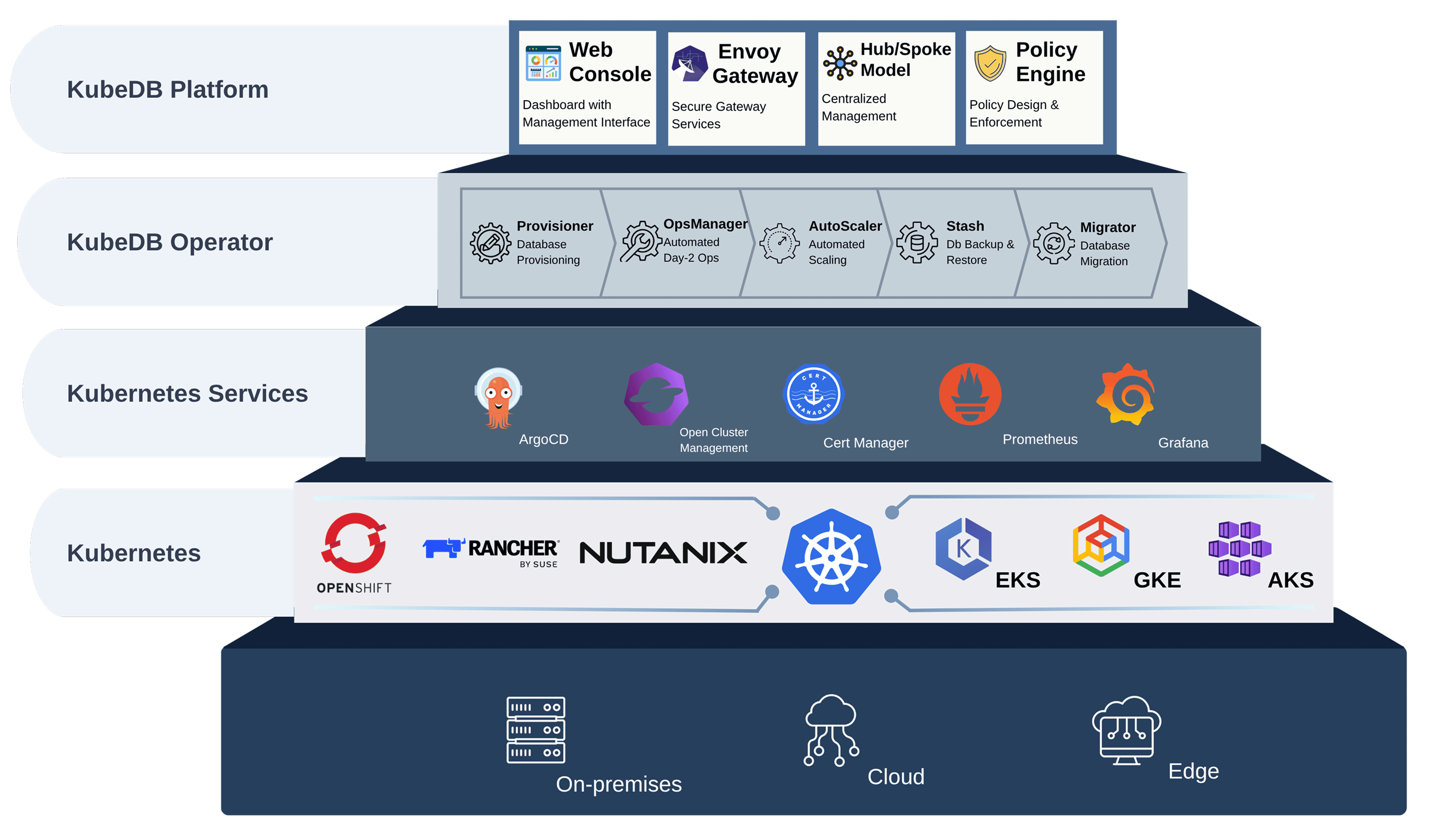
How It Works?
into a DBaaS platform.You Bring:
KubeDB Provides:
Frequently Asked Questions
Ready to Automate Your
Database Operations?
Kubernetes with KubeDB Operator

Amazon EKS
Run on Amazon Elastic Kubernetes Service
Google GKE
Run on Google Kubernetes Engine

Microsoft AKS
Run on Microsoft Azure Kubernetes Service

Red Hat OpenShift
Run on Red Hat OpenShift Platform

SUSE Rancher
Run on SUSE Rancher, REK2 & k3s

Nutanix Kubernetes Platform
Run on Nutanix Kubernetes Platform (NKP)

Mirantis Kubernetes Engine
Run on Mirantis Kubernetes Engine (MKE)

VMware vSphere Kubernetes Service
Run on VMware vSphere Kubernetes Service (VKS)